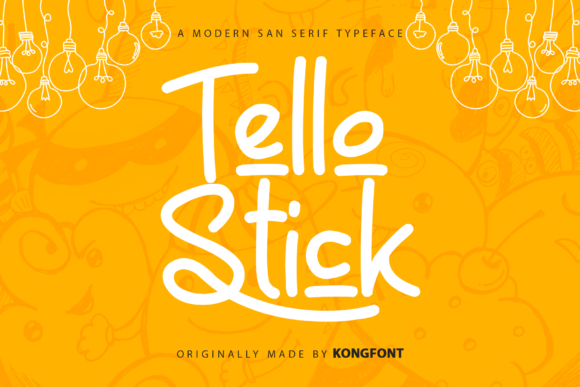
Tello Stick: A Handwritten Script Font for Modern Creators
Finding the right font can feel like searching for a missing puzzle piece. You have a design concept in mind, a color palette ready, but the typeface just doesn't fit. For projects that demand a personal, human touch without looking messy or overly formal, Tello Stick presents a compelling solution. This modern handwritten script font from Kong Font Studio strikes a balance between casual elegance and contemporary style, making it a versatile addition to any designer's toolkit.
Understanding the Visual Personality of Tello Stick
At its core, Tello Stick is a script font designed to mimic the fluidity of natural handwriting. It features smooth, connected letterforms with a consistent baseline and moderate contrast. The strokes have a slight, organic irregularity that avoids the sterile, mechanical feel of some digital scripts. This gives it a warm, approachable personality. It’s not trying to be a formal calligraphy font or a rustic, vintage script. Instead, it leans into a modern, playful aesthetic that feels current and relatable.
The font's appeal lies in its versatility. It works well at larger display sizes for headlines and logos, where its character details are visible, but it can also hold its own in shorter blocks of body text, like a pull quote or a caption, provided the background is clean. When you look at Tello Stick, you see a premium font that prioritizes readability and charm over complex, hard-to-read flourishes. This makes it a practical choice for real-world applications where clarity is just as important as style.
Where Tello Stick Truly Shines: Practical Applications
The true test of any creative font is how it performs in context. Tello Stick’s friendly, handwritten nature makes it exceptionally well-suited for projects where you want to connect with an audience on a personal level. Here’s where it excels:
- Wedding and Event Stationery: Think invitations, save-the-dates, menu cards, and thank-you notes. The font adds an intimate, celebratory feel without sacrificing legibility. It pairs beautifully with a clean serif font for details or a simple sans serif font for a modern contrast.
- Branding and Logo Design: For small businesses, boutiques, cafes, or personal brands aiming for a friendly, approachable identity, Tello Stick can be a cornerstone of the logo design. It communicates authenticity and care. Use it for the main wordmark or a tagline to inject personality.
- Marketing and Social Media: In the crowded space of social media graphics, a handwritten font can stop the scroll. Tello Stick is perfect for Instagram quotes, Facebook post headings, Pinterest pins, and email newsletter banners. It helps your message feel less like an ad and more like a note from a friend.
- Editorial and Publishing: In editorial design, such as magazine spreads, blog post graphics, or book chapter titles, it can add a human element. It works especially well for lifestyle, food, or fashion content where a personal voice is key.
- Packaging and Product Design: For packaging design, particularly for artisanal goods, handmade products, or gourmet food items, the font suggests craftsmanship and attention to detail. It’s a subtle cue that the product inside is made with care.
- Personal Projects and Crafting: For hobbyists and crafters, Tello Stick is a fantastic tool for creating custom cards, scrapbook layouts, planner stickers, and DIY printables. Its playful style adds a handmade quality to digital creations.
Integrating Tello Stick Into Your Design Workflow
Adopting a new typeface into your workflow requires a bit of strategy. Here’s how to think about using Tello Stick effectively:
Evaluate the Project Fit. Not every project calls for a handwritten font. Ask yourself: Does this design need warmth? Is the goal to feel personal or informal? Tello Stick is a display font at heart, so it’s best used for headlines, titles, and short phrases rather than long paragraphs. For body copy, always pair it with a highly legible serif or sans serif font.
Master the Art of Font Pairing. The key to using a script font like Tello Stick is balance. Pair it with a font that has a contrasting structure but a complementary mood. For a classic, elegant look, try it with a refined serif like Playfair Display or Lora. For a clean, contemporary vibe, pair it with a geometric sans serif like Montserrat or Poppins. The contrast in style helps the handwritten element stand out while maintaining overall visual harmony.
Consider Readability and Hierarchy. Use Tello Stick to establish a clear visual hierarchy. It should typically be reserved for the most important text element—the headline, the product name, the call-to-action. Ensure there is sufficient contrast between the text and the background. Avoid using it on busy, patterned backgrounds where the letterforms can get lost.
Review the Included Styles. When you download a commercial font like Tello Stick, check what’s included. Often, script fonts come with alternates, ligatures, or stylistic sets that allow you to customize the look of certain letter combinations. Experimenting with these can add even more uniqueness to your designs.
Understand the Licensing. If you’re using Tello Stick for a commercial project—a client’s logo, a product you sell, or marketing materials—you need to ensure you have the correct license. Kong Font Studio provides licensing options through platforms like Creative Fabrica. Using a properly licensed font is non-negotiable for professional work and protects both you and your client.
A Final Thought on Choosing Your Tools
In the world of modern typography, having a diverse library of design assets is crucial. A font like Tello Stick fills a specific and valuable niche. It’s not a workhorse for body text, nor is it an ultra-formal script. It’s a creative font designed to inject personality, warmth, and a sense of handcrafted quality into your projects. By understanding its strengths and applying it thoughtfully, you can enhance your brand identity, engage your audience more deeply, and create designs that feel genuinely human. The best tool is the one that helps you tell your story more effectively, and for many projects, that story is better told with a touch of handwritten charm.