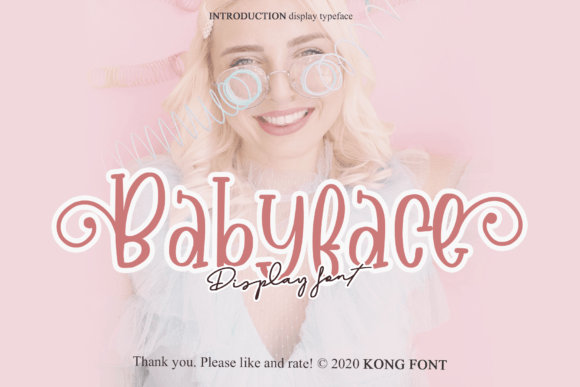
Why the Babyface Font Delivers Modern, Playful Energy
There is a specific creative challenge that arises when a project needs to feel personal but not sloppy. We often see handwritten fonts that look too chaotic for business use, or display fonts that feel too rigid for a fun invitation. Finding that middle ground—the sweet spot between professional polish and human touch—is where Babyface enters the conversation. Created by Kong Font Studio, this modern handwritten script font solves the problem of adding personality without sacrificing clarity.
The Visual Personality of Babyface
Typography is rarely just about the shape of the letters; it is about the feeling those letters evoke. Babyface is defined by its fluidity. The strokes connect smoothly, mimicking the natural motion of a hand holding a brush or marker. Unlike many script fonts that rely on heavy loops and aggressive slants, this typeface maintains a vertical, friendly stance. It is a modern typography choice that avoids the stuffiness of traditional cursive.
When you look at the characters, you will notice a consistency in weight that is rare for handwritten fonts. The terminals (the ends of the strokes) are cut cleanly, which prevents the text from looking messy when printed at smaller sizes. This makes Babyface a versatile display font. It has enough flair to grab attention on a headline but retains enough structure to be legible on a sub-header. It feels "premium" because of this attention to detail, elevating it above the thousands of free, low-quality handwriting options available online.
Where This Creative Font Fits Best
Understanding where to deploy a creative font like this is half the battle. Because of its "playful but polished" aesthetic, Babyface thrives in environments where you want to build a direct connection with the viewer.
Branding and Logo Design
For small business owners and entrepreneurs, your logo design needs to tell a story instantly. If your brand voice is approachable, modern, and human, Babyface is an excellent candidate. It works particularly well for lifestyle brands, boutique bakeries, wedding planners, or artisan goods. It conveys a brand identity that says, "We care about our craft, but we are also here to have fun." It pairs beautifully with a simple sans serif font for the body copy, creating a balanced visual hierarchy.
Crafting and Physical Products
The font is fully compatible with design software like Silhouette Design Studio and Adobe Photoshop. This compatibility makes it a favorite among crafters. Imagine using Babyface for heat-transfer vinyl on tote bags, mugs, or tumblers. The connected script style means fewer "jump cuts" when weeding vinyl, provided you use the correct settings. In packaging design, it adds a handcrafted feel to labels, making a product look homemade in the best possible way.
Digital and Editorial Use
In the realm of digital design, Babyface shines on social media graphics. It is bold enough to be read on a mobile screen in a feed. Bloggers and content creators can use it for Pinterest pins or Instagram stories to emphasize quotes or call-to-actions. In editorial design, such as magazines or lookbooks, it serves as a great accent font for pull quotes or photo captions, breaking up the monotony of standard text blocks.
Influence on Hierarchy and Engagement
Choosing a typeface is a strategic decision that impacts how information is processed. Using Babyface influences visual hierarchy by immediately drawing the eye. When set against a standard serif font or a neutral sans serif font, the script style creates an instant focal point. This allows you to guide your audience’s attention exactly where you want it—usually to the value proposition or the emotional hook of your message.
There is also the psychological aspect of brand perception. A font like Babyface lowers the barrier between the brand and the customer. It feels less corporate and more conversational. For a marketer, this is a tool for engagement. A social media post using a rigid, corporate typeface might get scrolled past, but a post using a friendly handwritten font invites a pause. It suggests that there is a real person behind the content, which is crucial for building community in today’s market.
Practical Guidance for Implementation
While the aesthetic appeal is strong, practical application matters more. Here is how to ensure you get the most out of this design asset.
Testing Readability and Pairings
The most common mistake with script fonts is overuse. I strongly advise against using Babyface for long paragraphs of body text. It is a display font meant for headlines and accents. If you try to write a full bio or a product description with it, readability drops significantly, and the visual texture becomes overwhelming.
When considering font pairing, look for contrast. A geometric sans serif font (like Montserrat or Poppins) complements the organic curves of Babyface. Alternatively, a classic, light serif font can provide an elegant counterpoint if you are aiming for a "modern luxe" vibe. Always test your pairings at the actual size they will be viewed. A combination that looks good on a 27-inch monitor might become illegible on a business card.
Reviewing Styles and Licensing
Before purchasing any premium font, check the character map. Does it include ligatures? Alternate characters? These features allow you to customize the look of the text so that repeating letters (like the two 'o's in "look") don't look identical, which enhances the handwritten effect.
Furthermore, verify the licensing. If you are a freelancer creating a logo for a client, you need to ensure the license covers commercial use and that the client is aware of the terms. Kong Font Studio typically offers licenses for various uses, but it is the designer's responsibility to ensure the commercial font is legally used in the final deliverable.
Compatibility with Tools
For those working in Cricut Design Space or Silhouette Studio, Babyface works well, but always perform a test cut. Sometimes, very thin strokes in modern typography can be fragile when cut from vinyl. If the strokes are too thin, you may need to offset the path slightly to ensure the material holds together. In Photoshop and Illustrator, the font renders cleanly, allowing for easy scaling and color changes necessary for web design mockups and print files.
Conclusion
Babyface is more than just a collection of letters; it is a tone-of-voice tool. It allows designers, marketers, and crafters to inject a dose of humanity into their work. Whether you are building a brand identity from scratch or refreshing your social media graphics, this typeface offers a reliable way to be playful without being childish. It strikes that difficult balance, making it a valuable addition to any creative professional's font library.